Showing posts with label bamboo. Show all posts

Saturday, June 7, 2014

Is bamboo drought tolerant?

As of this post, California is in the grip of a pretty serious drought - one that has been around for about two years, but in 2014 turned quite severe.  Pretty bad.  Though thankfully the March 2014 storms have provided some relief, but certainly the drought is not over by any stretch and this summer will prove to be a challenging one.  As I know that this is top of mind for many of you - I wanted to address a very common question that I have been asked over the years - "Is bamboo drought tolerant?"

Yes, somewhat - but it really depends.

OK, so not the clearest answer, but let me explain.

Clumping bamboo tends to be more drought tolerant that its running cousin because it grows slightly deeper, on average.  This lends the ability to have more water supply opportunities for the plant, much like a tree with a deep taproot would.  However, generally this would require the bamboo to have a mature, established root mass.  So, if your planting a brand new bamboo plant, don't expect to treat it like a California Poppy (which is a very drought tolerant California native plant).  A new bamboo plant, like most plants, require regular water in the first full going season for the roots to grow and become established.


Bambusa ventricosa 'Buddha's Belly Bamboo' and Bambusa multiplex 'Alphonse Karr' (both far left of photo) doing well in our water efficient front yard.  By removing the front yard grass and watering efficiently in both the front and back yard, we realized a 58 percent reduction from the same time last year.

After that, you could be moderately miserly, to some extent with water, but the trade-off is that the growth of the bamboo plant will slow and it won't be as lush as it would with a consistently moist soil.  But there are limits, and your bamboo plant will show it with yellowing leaves and curling leaves.

So, one other myth to dispel (bamboo carries a lot of myths with it) - bamboo likes soggy, wet soils.    In fact, many visualize bamboo you see in the jungle - jungles get a lot of rain and thus all bamboo must like soggy soil.  Well, not really.  Some bamboo can tolerate soggy soils, but the vast majority do not.  If fact, soggy soils over an extended period of time lead to root rot, which will ultimately kill the bamboo plant outright.  Don't get me wrong, bamboo likes regular watering, like an average medium water use plant, and can tolerate some dryness, but moderation is the key.

So - with this drought - here are some easy strategies to keep your bamboo happy and while using water wisely.

- First, mulching is a great way to extend moisture around the plant and slow evaporation of water.  Plus a good mulch offers other fertilizing benefits to the bamboo as well.

- Supplement your water that would have normally gone down the drain.  Many Californians are using a low tech solution to capture and use water that would have normally just gone down the drain.  While warming your bath or sink water, put a bucket to capture that water.  Use the water (at room temperature) to water your bamboo.

- Water your bamboo plant in the early morning to minimize evaporation and allow the plant to maximize the intake of the water provided, before air temperatures rise.
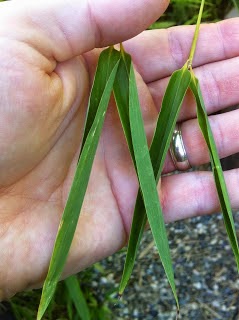

Tell-tale sign that your bamboo needs watering.  Curling of leaves.

- Pay attention to your bamboo plant - if you get leaf curling, its a signal that your bamboo needs to be watered.  Short periods of dryness are OK - but don't push it.

For many, droughts offers unique opportunities to learn and adapt to extraordinarily dry conditions.  Bamboo can survive in a drought, it just takes a deeper understanding of the plant and its needs, coupled with common-sense water efficiency practices that apply really to any type of landscape circumstance.

Sean
Mad Man Bamboo Nursery - Rocklin
www.madmanbamboo.com
Facebook - www.facebook.com/madmanbamboo
Twitter - @madmanbamboo

Saturday, September 14, 2013

The best containers to grow bamboo in...

Ah, a moment of spare time - I finally have a chance to get back to this blog, break the radio silence and talk about a topic that I have been thinking about and get asked about alot - "What kind of container should I use for my bamboo?"

Bamboo lends itself to growing quite well containerized.  In most cases, due to my relatively cautious nature and past experience, will advise most people to always containerize their running bamboo, due to its invasive nature when uncontrolled.  Additionally, there are several clumping bamboo, such as Bambusa ventricosa 'Buddha's Belly Kimmei' that show off its best characteristics (bulbous 'belly' culms') in a container (pictured below).


So what is an ideal container for bamboo?  Here are some ideas:

1.  My favorite container is a metal horse trough, like these that I bought today.  Simple, sturdy and best of all, the sides are at a 90 degree angle.  Additionally, bamboo likes horizontal space and depth is not a priority (2 feet is typically adequate for depth for most bamboo).  Be sure to drill a few drain holes at the bottom for good drainage.


2.  I always stay away from pots that taper at the top - always go for straight side or pots that are "V' shaped.  When it tapers, the bamboo root mass will tend to fill the pot's growing space completely making any future attempt to pull the the bamboo out an exercise in futility.


3. Always get a container that allows water to drain.  Bamboo does not like to sit in water and 'wet feet' will cause the plant long-term harm up to death over time.  Word of caution though, if you have a container that has a running bamboo and the container is on the ground, be sure to put a paver underneath the drain hole.  Otherwise running rhizomes, will escape (pictured).  This does not apply to clumping bamboo.


4. Think outside the box - bamboo is a unique plant - use the recommendations above, but get creative and bring out the best in your beautiful, unique bamboo.


Use these recommendations and your bamboo will be happy and healthy in its new home above the ground. Cheers!

Sean
Mad Man Bamboo Nursery - Rocklin, CA
www.madmanbamboo.com
Facebook - Mad Man Bamboo
Twitter - @madmanbamboo

Wednesday, September 3, 2008

Toastmasters Speech: The Wonderful World of Bamboo; One Happy Garden Punk

One Happy Garden Punk

I had a bamboo plant sale this past Saturday and finally met Katie at Garden Punks. Katie ended up buying bambusa multiplex "Alphonse Karr," [pictured] a clumping bamboo that has ornamental beauty and serves as a great privacy hedge. Based on Katie's post, she seems to be one happy Garden Punk with her new bamboo plant. Maybe another "bamboo geek" in the making? We shall see. More on Katie's experience here.

Toastmasters Speech: The Wonderful World of Bamboo

Never fails. I was ready to give my Toastmasters speech today at noon and sure enough, I was called away to another work matter and wasn't able to attend my lunchtime Toastmaster's meeting. Oh well, I'll keep this one in my hip pocket for another day. But, hey, why not share with you all:

"The Wonderful World of Bamboo

Your planting bamboo! Eeek!

Don’t you know that that stuff will take over your yard, your neighbor’s yard?

Bamboo is a misunderstood plant that people fear because they heard a story from long ago or blindly planted it without doing the research necessary.

Or they were misled by a “nursery professional” eager just to offload a plant and make a quick buck.

I own a small backyard nursery and have about 60 types of bamboo plants in my collection.

I often hear horror stories about bamboo, but I am finding that my customers are doing the research and embracing bamboo as a plant with huge potential.

Bamboo, after all, serves many purposes;

It’s beautiful – it comes in many colors, sizes and shapes and brings something special to the garden.

Its functional – they come in both running and clumping species.

Runners are the aggressive version of bamboo that causes fear. If planted in a decorative pot or if you have some space, it can serve as a beautiful addition.

[Demo running graphic]

Runners can fit in a suburban garden; however, a 2 ½ foot deep plastic rhizome barrier is a necessity

Over the past decade, clumping bamboo has been introduced to the U.S and offers a less aggressive alternative. Clumping bamboo grows slower and at a much smaller distance making it easily controllable.

[Demo clumping graphic]

Bamboo has environmental benefits –

A grove of bamboo sequesters 35% more carbon than an equivalent stand of trees.

It’s a great alternative to hardwoods and regenerates quickly, in a matter of years, not decades like a forest.

The fastest culm growth has been clocked at 2 inches an hour in some species.

Bamboo was the only living thing to survive at ground zero of the 1945 Hiroshima atomic blast and its survival allowed for the quick re-greening of Hiroshima .

So how can you become educated about bamboo?
With the increasing popularity of bamboo, there are a lot of resources out there to learn more.
One is the American Bamboo Society, which I am a member of, that publishes scientific journals and a more user friendly magazine for members. They have a couple of public sites:

www.americanbamboo.org

www.bambooweb.info

These sites have pictures, plant information and sources to by bamboo. My business happens to be on this site.

There are also many books that have been published that are great resources.

Also, there are many folks out there, especially through the American Bamboo Society, that are more than willing to answer questions about bamboo.

After doing the research, you’ll find that bamboo will likely serve many purposes.

OK, I leave with a new trick - how to determine a runner from a clumper (not 100% applicable, but is in most cases).

[Demo this - for most bamboos, you can tell a runner by the vertical groove on the culm, for a clumper it is all smooth with no vertical groove]

With a little education, bamboo goes from an “invasive weed” to a functional, beautiful plant that can offer privacy, lend beauty and, dare I say, maybe even help save the planet?

That bit of education is all it takes to get to know and appreciate the Wonderful World of Bamboo."

Have a nice evening!

Sean

Tuesday, June 24, 2008

The Unintended Garden

Sometimes the best garden are the most neglected.... in this case completely unintended. Last fall, prepping a newly planted bamboo plot for winter I used some of the "rough" compost from my bin. The same one that we put grass clippings, leaves and kitchen waste (seeds and all).

With hot weather hitting northern California over the past few weeks, new vegetables began cropping up, a squash (neither of us know what variety it is) and a tomato plant (either a big version of a cherry or maybe a Roma). These plants are thriving among the bamboo, the squash plant is even using the bamboo to climb. Since I have been using natural fertilizers, blood meal for nitrogen and bat guano for potassium and phosphorus, the bamboo and its new vegetable neighbors seem very happy, completely neglected and doing great.

Sean

Saturday, June 21, 2008

My weekend: Bamboo in the country

A few sore muscles and a couple of blisters later, my dad and I finished two raised planter boxes and planted four types of bamboo on their three acres in Grass Valley, CA. Although I do live on a larger-than-normal suburban lot, I do not grow running bamboo in the ground (I like to have neighbors that like me). So, the offer was made by my parents to use the land they have and I took them up on it. There is enough water and enough room for them to grow.

The four types are:

p. nigra "Black Bamboo": A big seller, full sun, up to 30 feet tall and can take -5 f.

p. edulis "Moso": One of the biggest in the world, the culms are furry to the touch, 75 feet tall, and 7 inch diameter culm, this is a big boy. Can take temps down to 0 f.

p. bambusoides "Castillon": Another favorite, yellow culms with green stripes, leaves are striped. Young shoots also take on a red color. 35 feet tall, can take temps down to 0 f.

p. bambusoides "Giant Japanese Timber Bamboo": Name says it all. 72 feet, 6 inch culm diameter. Full sun, can take temps down to 5 f.

We may be expanding bamboo grown at my parent house and also possibly more planters for fruit trees and more vegetables (they have a small plot now).

I'll share photo updates next year to show growth.

Sean

Sunday, April 6, 2008

Holes and cutting out bamboo... I'm tired!

No, this is not a problem with gophers. Me, one jackhammer, and soil full of river rock. Pictured is rock that is in the ground all over my yard, after all I live in a town named Rocklin. Determined to get the momentum going on finishing my backyard, I rented a jackhammer to get the soil ready for plants of all kinds including several Japanese Maples that we have had in pots for a few years, bamboo, some lavender plants and a bunch of unique plants we have picked up at the plant sale recently.

Four hours, lots of noise later, some blisters on my hands and some sore muscles, mission accomplished, but I'm exhausted.

I also knocked out removing half of a mature Golden Goddess Bamboo, a clumping bamboo we planted several years ago. The problem is that it tends to have more of a drooping growth. What's great though is that this variety by far is my best selling bamboo variety and this year I actually ran out because its selling so good, so I took the clumps and potted them, they'll be ready for sale by fall. Once I finish the job, we are planting Thamnocalamus tessellatus "Bergamboes," a South Arican bamboo that grows straight up, is dense, is a clumper and provides privacy.
OK, I'm tired, time for bed, sweet dreams everyone.......

Sean

Sunday, March 16, 2008

Natural or Not? Results of fertilizer experiment in my garden.

On December 27, I began my very un-scientific experiment to see what yielded better results on my bamboo. A slow release Osmocote or the natural alternative, rough compost (that is a slow release natural alternative). Now, I know that Osmocote's release is governed by moisture and temperature; however, after using Osmocote for years, I am familiar with the results even in the ideal release conditions for Osmocote.

The results are in and so far, by mere observation, the all-natural compost is yielding the best results. The most evident is on my potted Moso (Phylostachys edulis) bamboo. I counted 13 new culms that burst from the ground, that's compared to my other 3 potted bamboos that just had Osmocote applied. Now granted there may be variations in species that may influence the results (like time of year they shoot), but looking at my three clumping bamboos that I also applied compost to in December, I am seeing similar favorable results. That said, this experiment has brought me to the conclusion that going all natural in terms of fertilization seems to yield healthier more vigorous plants.

One a related note..... yesterday, in an effort to "heat up" my compost bin, I purchased a box of blood meal (13-0-0) from the E.B. Stone Company and applied it to my bin. I also applied some to the soil of my bamboo plants. I'm hoping the shot of nitrogen, which bamboo can't get enough of, will really encourage new growth and green the plants.

Time will tell.....

Sean

Monday, February 18, 2008

Another day in the yard...

Decent temperatures today... mid 60's, rain forecast for tomorrow. That is a perfect time to propagate bamboo, as the temperature is just right and any propagated bamboo would certainly appreciate the rain-bound moisture to fight the shock from being pulled from the ground.

This is a culm of bambusa ventrosica "Buddha's Belly Kimmei." The Kimmei feature is the stripes and mature culms turn yellow with green stripes Note that I kept the dead portion on the culm which is a way to keep the frost (which we are not out of the woods yet here in California) away from live growth, despite my temptation to cut it off. Once I am free and clear of frost, this portion will go.
I was able to get two culms of the Buddha's belly and one from my Silverstripe bamboo which has a white stripe and interesting zig-zag growth (fourth photo).
These will be ready for sale in late summer/early fall. Couldn't pass up this perfect date to propagate bamboo.
Finally, I wanted to say how amazed I am with a cyclamen we planted that came from a family friend. No exageration, this cyclamen has looked the same from early spring 2007 through now. I love this plant!

Spring has almost sprung!

Sean

Saturday, February 16, 2008

Day at the Sacramento Zoo...

It was a beautiful day in Sacramento, California. Took a trip to the zoo and caught some great photos of bamboo and other interesting plants (as usual, a big plant geek, I paid little attention to the animals). The first two pictures are of a Monkey Puzzle Tree. The next picture is of a blooming Camelia bush. The last three are of bamboo, the tall ones being "Japanese Giant Timber Bamboo" and the last a very interesting culm of what I think is phylostachys aurea "Holychrysa."

Enjoy!

Sean


Friday, February 15, 2008

Growing bamboo in containers.....

Paul from Boston sent me an e-mail regarding growing bamboo in pots. Yes, this can be done and if you live in a suburban garden like mine, its a good way to enjoy running varieties without having them in the ground. For those living on a small lot with neighbors nearby, I never recommend running bamboo unless (1) you have a rhizome barrier installed or (2) they are container grown. Unlike clumping bamboos, most running bamboos can be very aggresive and can be a source of neighbor-to-neighbor strife.

I have had success growing bamboo in a containers in a couple of different ways. My black bamboo (phylostachys nigra), pictured above, is growing with some gusto in a metal horse trough that I got for free from my neighbor. Depending upon the style of your garden, they can be attractive.
Using a drill bit made for metal work, I drilled several holes in the bottom, created an airgap by placing the trough on bricks. This is dome to prevent rhizomes from escaping the container and into the ground below.
I have also planted four runners in glazed ceramic pots (pictured is phylostachys bambusoides "All Gold"). If have read some literature recommending unglazed to let the soil breathe, but on the flip side unglazed during the summer tends to dry out the soil in the pot. Especially here in Sacramento, where we get several days of temps over 100f in the summer. That can mean a dead bamboo plant - real quick. All that said, I have had nothing but success using the glazed pot.

Like the trough, I have the glazed pots sitting on granite pavers I had left over from our front yard landscaping project last spring.

The other question from Paul is the size and height of container grown bamboo plants. My observation is that they do not get as big or robust as a running bamboo planted in the ground. That fact is true for most plant's size as the pot physically controls the development of the root growth.
Container grown bamboo put in a decorative container adds style and interest to any garden.
Try it out sometime....

Sean

________________________________________________________

Like this post? Check out our other sites with much more information on bamboo:


Facebook: Mad Man Bamboo

Tuesday, February 12, 2008

Can bamboo grow in extremely cold temperatures?

Fellow garden blogger Kate from the very popular and very well written "kate smudges in earth, paint and life" and I somehow got on the topic of bamboo. She commented on one of my latest posts, "It's doubtful there is a bamboo that I could grow in my garden," Kate, hails from Saskatchewan, Canada, rightfully so with extreme cold and snow, held this reasonable assumption that bamboo was out of the question. But, in all my bamboo geekdom, replied back "oh contraire" and offered some suggestions. Kate then replied back expressing interest. So knowing a fair amount of fellow bloggers and loyal readers hail from regions of the U.S. and Canada that have extereme winters, I thought why not share this post with all.

OK, the toughest family of clumping bamboos that I have in my collection are the Fargesias. Fargesias come from the the alpine conifer forests of west and southwest China. These are beautiful in delicate sense (in appearance only) and some can be found in mountain elevations as far up as 8,000 feet. On average, these bamboo can take -20 f per the respected American Bamboo Societies source list. The toughest of them all is Fargesia dracocepela (also known as Dragon's Head Bamboo) that lists a minimum temperature at -23 f. Pictured above is the closely related White Dragon Bamboo (Fargesia dracocephela "White Dragon") growing in my garden.

For running varieties, here are some tough cold tolerant varieties:

Phylostachys bissetti at - 15f (very wind tolerant as well)


Phylostachys aureosulcata "Spectabalis" at -10f (yelow culms with green stripes and red at nodes - I have this in my collection, very pretty.

There are a few more that are at -5f to -10f cold tolerance.

So, check out the American Bamboo Societies source list online and you'll be amazed. Photos of these bamboos can be found at http://bambooweb.info/.
Many thanks to Kate for bring this question up, hope its useful or at least interesting.

Sean

Like our posts on bamboo? 'Like' us on our Mad Man Bamboo Facebook Page for more photos, information and tips.

Saturday, February 9, 2008

Bamboo Trek, Part 2: The little mini-van that could......


Today for me was the first say of spring, albeit a bit early. Getting ready for my upcoming plant sale on March 22, I made my annual pilgremage to my bamboo wholesaler. My mighty green mini-van yet again rose to the occasion and servred as the delivery van for the bamboo trek.

First, the seats are taken out, then the back seat is folded into the bottom cavity. This turns the family van into an instant cargo van.
Drop a tarp in the back and I was ready to roll.
Left Rocklin this morning at 7:00 a.m. for my 9:00 a.m. appointment.

Went through my wish list and loaded an amazing 31 five gallons into the back of the van (previous record was 32 five gallon pots). No worries, bamboo clums are generally very pliable and do not sustain damage, unlike trees or other plants.
Got home and was time to unload.

I'm sure my neighbors were wondering what the heck I was doing, especially with the sheepish grin of satisfaction on my face.

When all was said and done I was pooped. But its all worth it. My growing and selling season has begun officially. With highs in the low 60's today and new bamboo plants to oggle over, I can't help but feel like spring is here.

Photos of the new bamboo additions are forthcoming, but I'm pooped, time for some shuteye.

Sean


Monday, January 28, 2008

Bamboo trek: Spring is almost here!


For me, the beginning of spring is signified by my first trip to my wholesaler to get ready for those "green thumbs" and bamboo collectors looking to add more bamboo to the garden. Since clumping bamboo (the mild non-invasive cousin of the running bamboo) is fairly easy to get, the options abound for really any type of landscape idea or need.
This will also help me prepare for my (aka Mad Man Bamboo's) first plant sale of the season at the Shepard Arts and Garden Center at Sacramento's McKinley Park on March 22, by supplementing the stock I grow on site with other varieties not available to me. The sale is put on by the Sacramento Perennial Plant Club and the table rent proceeds and auction help support their good organization.

The date for my bamboo trek is set for a couple of weeks from now and am using my handy-dandy American Bamboo Society Species/Source list (my weathered 2006 list pictured) a must for any "bamboo geek" like myself, to gather my wish list.

For me, this is like a kid in a candy store, and I am sure to come back with more varieties for my customers and a couple here and there for my personal collection.

More posts to come.....

After pretty much shutting down for the winter, this bamboo trek means the season is officially on for me. Spring can't come soon enough, I'm sure you fellow "green thumbs" are with me on that!
Sean

Wednesday, January 16, 2008

Bamboo homes from Hawaii

Ran across this site - Bamboo Living Homes by Bamboo Technologies. Real bamboo homes made by a company out of Haiku, Hawaii. It's a very interesting alternative to the bland vanilla stucco production homes that you see here in many parts of California (and most of the nation).

Looks like they harvest the bamboo in Vietnam using a clumping variety, bambusa stenostachya, or "tre gai".

The site covers all aspect of bamboo harvesting in Vietnam, fabrication, shipping and assembly at the home site. Interesting concept and from the website, the homes have some real architectural interest and nice finish work. You can take a virtual tour of the company's model home in Kaui.

Now if I had some spare cash lying around and a lot in the country.... hmmm... OK time to stop dreaming.

Cheers!

Sean

Thursday, January 3, 2008

"Mad" over bamboo

Growing bamboo for me is fun, I appreciate the beauty of the plant and selling it gives me the opportunity to interact with a variety of people, those that appreciate plants and gardening more than most. My business is unlike any other, I grow bamboo, part-time and sell by appointment and at local plant sales. No store front, low overhead and on my own terms.

My business is small and low key, makes enough money to support my bamboo collecting habit, but not so intensive that it infringes on my personal life.

Many of the people that visit ask how I got into plants and bamboo. I attribute it to my mother-in-law who really introduced me to gardening, morphed into tinkering and growing Japanese Maples. Japanese Maples are beautiful, but for a lazy gardener like myself, they required alot of attention and time and not much profit when all was said and done.

Bamboo is easy to grow and I appreciate the challenge of overcoming the mis-information on bamboo (that all bamboo is invasive). The perfect plant for the laziest of gardeners. The colors, shapes and leaves offer a big payoff for relatively little effort.

I also have found strength in my business is through carrying bamboo varieties that cannot be found in this area and operating within a niche that can coexist among the big boys like Home Depot, Lowes.

I also figure that my low key business model is a nice slow intro to the nursery industry. Once I can financially pull it off to buy some land, maybe I'll open a storefront nursery in the country.

Finally, through my website - www.madmanbamboo.com I'm amazed by the extent by which people are interested in bamboo, getting web hits form all over Europe, east Asia, South Africa and all over the U.S.

So, what up with the name - Mad Man Bamboo? The name came from my wife who says I'm "mad" about bamboo. That's in crazy through obsession. But its a good obsession that keeps me happy, so its all good in my book.

Cheers!

Sean
Mad Man Bamboo
www.madmanbamboo.com

Thursday, December 27, 2007

Experiment - fertilizing naturally or not, what makes a better looking, healthier bamboo?


In my ongoing renovation of my backyard, I began focusing on the southwest corner of my yard. I planted four (likely will be five by tomorrow) bamboo, f. murileae "Umbrella Bamboo", t. crassinodus "Kew Beauty", t. crassinodus "Merlin", f. robusta and the fifth will be b. fungosa.
Trying to grow using more natural methods, I opted to use compost from my bin (pictured) which now has a good mixture of leave and grass debris and recently (3 months or so) we began including kitchen scraps from fruits and vegetables. Needless to say after finally being good about turning the compost, we are starting to get some rich compost.
So, for the past couple of years, I have been using Osmocote to fertilize my bamboo as a slow release and have been fairly happy with the results. However, becoming more aware of the impact of synthetic fertilizers, I am going to try something different on these five newly planted bamboos.

When I planted them, I put a thin layer of compost on top, not only to protect the root structure from frost, but as a natural fertilizer.

Pictured are the subjects of the experiment (from left to right) t. crassinodus, "Kew Beauty"; f. murileae "Umbrella Bamboo" and f. robusta.
Let the experiment commence!
Sean

Tuesday, December 18, 2007

Great bamboo resource and a venue to trade (and buy)) bamboo plants if your a collector

Aptly named, I am a "bamboo geek." I collect bamboo, like it were stamps, comic books or coins. With hundreds of varieties in the U.S., there is plenty to collect and living in California (with great weather, comparatively speaking) allows me the opportunity to collect running and the mostly sub-tropical clumping bamboos.

A great resource for the beginning collector to the expert nursery operator is bambooweb.info. Partially funded by the American Bamboo Society, it is a great venue to get advice on growing bamboo, pests and diseases and the best part, trading (or buying/selling) with private collectors.

I recently completed a transaction with a fellow collector in the south bay area and I was happy with the results.

This is the site to check out if you appreciate bamboo, like I do - http://www.bambooweb.info/bb/index.php