Sunday, February 13, 2011

Adventures in Composting: Putting together our tumbling composter

A couple of weeks ago, we bought a tumbling composter after our box composter had some critter issues.  My wife likes to incorporate fruit and vegetable scraps into the compost pile, but that can lead to some unwanted critters making home in the compost.  Last summer, I opened the top of the old composter and a small rat leaped (literally) from the composter to the tall Photinia bushes nearby, a mere four feet.  Needless to say, it scared both the rat and me.

So, we went with the fully enclosed and raised tumbling composter.  Of course, what I am looking for is some good rich compost to supplement my soil for bamboo and other plants in the garden.


The first chuckle as we assessed the adventure ahead of us was the statement on the large blister pack full of screws, bolts and parts - 'Hardware is actual size."  Really....


The composter's brand was Lifetime, no doubt branded to mean it lasts a lifetime, but after today, it felt like a lifetime to put it together.  You know your in for it when you have to use a drill, it has instructions in six languages and it says "takes two adults to assemble."  Throw in some blood-thirsty mosquitoes and it's a good time!


After a few choice words and a few screws leftover, we constructed the tumbling composter.  Rich dark beautiful compost, here we come!

Sean
Mad Man Bamboo
(916) 300-6335
www.madmanbamboo.com
Mad Man Bamboo on Facebook
Twitter: @madmanbamboo

Saturday, February 12, 2011

Bamboo pruning tip: 'Legging Up' gives bamboo that classic look


Often when thinking of bamboo in a nicely manicured garden, it's common to associate it with long, exposed vertical culms (canes) topped with nice green, dense foliage.  Neat, sleek and clean looking - there is a way to prune bamboo to create this 'classic' bamboo look, called 'Legging up.'

'Legging up' involves pruning thin, weak culms from the plant; and cutting off the branches and leaves from the nodes from the lower three to four feet of the plant. Use a sharp pair of pruning shears to make clean cuts both in thinning culms; and in cutting the branches and leaves from the nodes.   'Legging up' should be done around May for clumping bamboo and September for running bamboo.

It's easy to do and is actually beneficial to the bamboo plant because it opens up the interior to more sunlight and airflow.  Further, the loss of old leaves puts more energy back into the root mass to further future culm development and the generation of new, fresh leaves.

Many Sacramento area homes have pools that have a tropical-style landscape.  'Legging up' bamboo in a tropical landscape offers the lush green upper foliage (for privacy) while showing off the beauty of the culms, giving that true 'jungle feel' to any yard.

Bamboo varieties that lend well to 'legging up' include:

Clumping

Bambusa multiplex 'Alphonse Karr' (pictured above)
Bambusa oldhamii 'Giant Clumping Timber Bamboo'
Bambusa ventricosa 'Buddha's Belly Bamboo'

Running

Most of the Phylostachys species; 30 feet and taller (includes 'Black Bamboo' and Phylostachys bambusoides 'Castillon')

'Legging up' is an easy pruning technique that lends well to Asian-style and tropical-style gardens.  It's good for the plants and shows off the beauty of the culms that would naturally be covered in foliage if untouched (like a bush).  It's also a great way to keep your bamboo plant healthy as well.  Give it a try and you'll be happy with the results.

Sean
Mad Man Bamboo
(916) 300-6335
www.madmanbamboo.com
Mad Man Bamboo on Facebook
Twitter: @madmanbamboo

Monday, February 7, 2011

Stroll through Capitol Park (Sacramento)... and find a beautiful bamboo grove!

Today, I took a longer way to head to my car (headed home) after a meeting at the Capitol Building through Capitol Park. I had heard of a really nice bamboo grove in Capitol Park (Downtown Sacramento) but had never encountered it.  Ironically, I had worked in downtown Sacramento for seven years (1998-2005) and had visited the Capitol Building for work several times a week but never encountered this bamboo grove.  Now, I go once a month or so and I found it, funny how things happen.

So...  walk down 13th and L St. (towards Capitol Park ) towards the bright white Capitol Dome and you'll see this:


Phylostachys bambusoides 'Japanese Giant Timber Bamboo', immaculately maintained.


Up front, beautiful culms.


Picture perfect.


And an awesome grove of 'Cooking Bananas', biggest I have ever seen in this area.

Drop by Capitol Park, if you haven't seen this bamboo grove, it's worth seeking out.  A gem in the heart of Downtown Sacramento

Enjoy!

Sean
Mad Man Bamboo
(916) 300-6335
www.madmanbamboo.com
Mad Man Bamboo on Facebook
Twitter: @madmanbamboo

Saturday, February 5, 2011

What's that poking out of the ground? Bamboo shooting season is almost here.

For a 'Bamboo Geek' like me it's an exciting time of year.  Late Winter/early Spring is the time of year when running bamboo starts shooting brand new culms (canes).


Culms come out and look nothing like their eventual final form.  Bright colors, spots, interesting forms all make 'shoot watching' an interesting obsession.  If there were a 'plant watching' hobby (like bird watching) staring at fresh bamboo as it emerges from the ground would be top on the list, at least for someone like me (yes, I know - very strange).


So... with great anticipation, I present my predictions for when the new shoots will emerge from the ground here in the Sacramento area.  This assumes moderate temperatures like we have had recently prevail; and some moderate precipitation continues as well.  Other conditions that can influence shooting are - fertilization and sun exposure, so expectations should be somewhat tempered based on the conditions of your garden.  This is a list of some of the more popular running bamboo varieties that I expect to shoot soon:


Early shooters - right now: 


Pleiobalstus viridistriatus 'Dwarf Greenstripe'


Pleioblastus fortunei 'Dwarf Whitestripe'


Pleioblastus pygmaeus 'Pygmy Bamboo'


Phylostachys edulis 'Moso' (Giant Timber Bamboo) - March 7 - 14 (pictured above)


Phylostachys aurea 'Spectabilis' (there is alot of "Golden Bamboo', a close cousin of 'Spectabilis', growing in the Sacramento area, especially up in Placer County) - April 1 - 8 (pictured above).


Phylostachys nigra 'Black Bamboo' (Sacramentan's love Black Bamboo) - April 15 - 30


Phylostachys nigra 'Leopard-Skin Bamboo' - April 15 - 30 (pictured above).


Hibanobambusa tranquillans 'Shiroshima' - May 15 - 22


If you are a Bamboo Geek, you will enjoy this time of year,  Sacramento is a great place to grow bamboo - decent rainfall, lots of sun and plenty of opportunities to use running bamboo (contained is suggested).  Be it in a container or planted with a rhizome barrier, keep your eyes open the next few weeks, something may be emerging from the garden floor from a long winter's sleep.  Enjoy it, it is quite a sight.


Sean
Mad Man Bamboo
www.madmanbamboo.com
(916) 300-6335
Mad Man Bamboo on Facebook
Twitter: @madmanbamboo

Sunday, January 30, 2011

Miniature bamboo: Short on stature, but not on beauty...

When most people think of bamboo, its natural to think of a tall, upright grove or forest, full of beauty.  Some beautiful examples of large bamboo specimens can be found in places such as the Sagano Bamboo Forrest at Arashiyama on the outskirts of Kyoto, Japan; or the famous bamboo groves found on the way to Hana on the island of Maui, Hawaii.  Some of these groves have culms as tall as 75 feet.

Contrary to what many think of as the most beautiful bamboo, some of the most beautiful bamboo, in my opinion, are four feet or less - what I call - 'miniature' bamboo.   These small bamboos offer some dazzling qualities that can add interest to most gardens.  Ironically enough, despite their small stature, these small running bamboo are among some of the most aggressive and are recommended to be used as potted plants only, unless you have room for these small plants to roam.  As a landscape plant, these 'miniature' bamboo plants are often used as a groundcover.

Here is a sample of what I consider to be the best of the 'miniature' running bamboos:


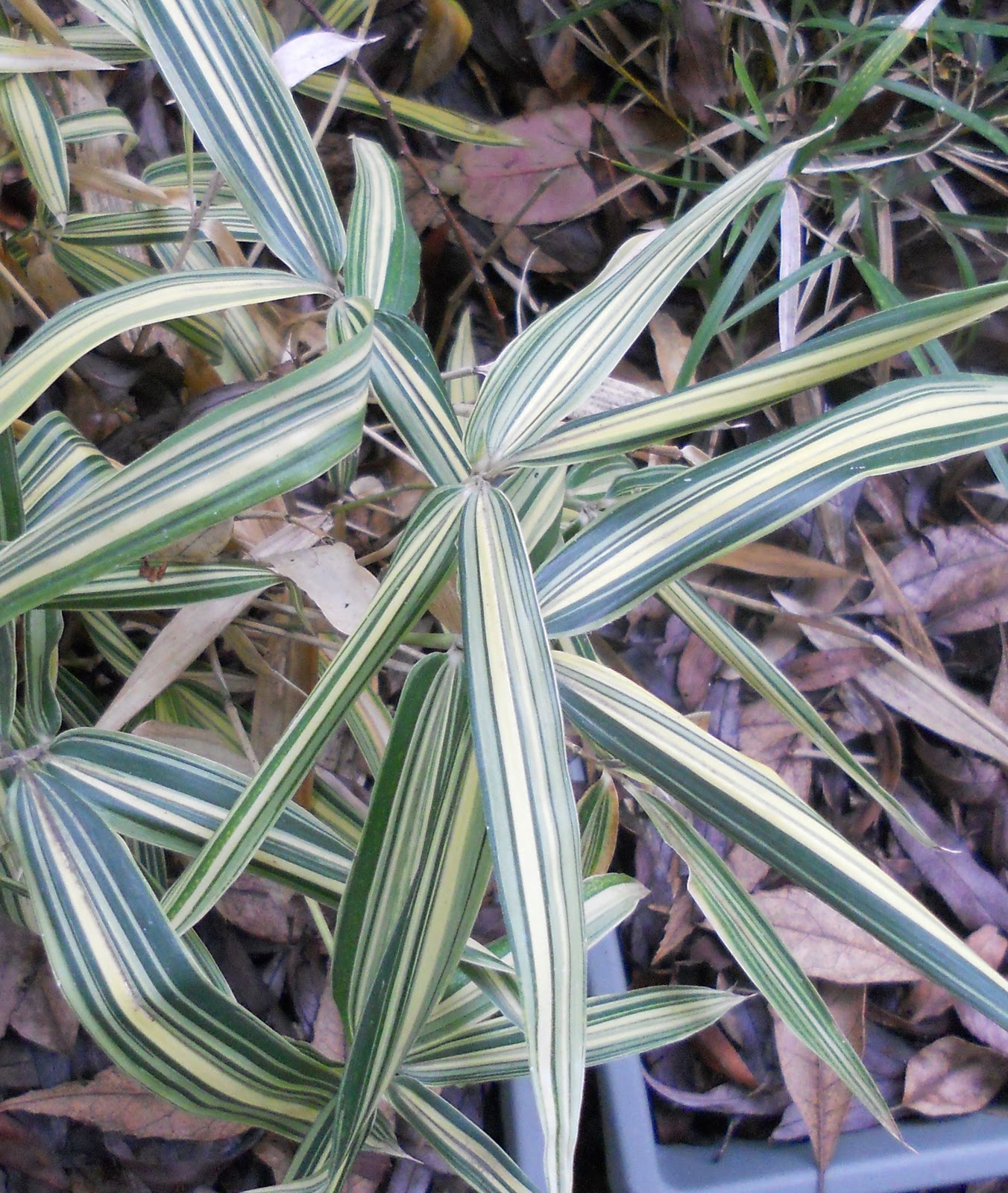
Pleioblastus humilis 'Albovariegatus' - less than four feet - some afternoon shade.  This variety was introduced into the United States by the late bamboo pioneer Gerald Bol in 1994.


Pleioblastus viridistriatus 'Dwarf Greenstripe' - less than three feet - needs mostly shade, especially in the afternoon (even more important in Sacramento's hot summer afternoons).


Pleioblastus fortunei 'Dwarf Whitestripe' - less than four feet - needs mostly shade.

Some other interesting bamboo 'miniatures' include - Pleioblastus distichus 'Mini' (less than one foot); Pleioblastus  linearis 'Nana' (less than four feet) and Pleioblastus akebono (less than two feet) and Pleioblastus pygmaeus 'Pygmy Bamboo' (less than two feet).

Some other interesting smaller varieties that are not 'miniature,' but work well for containers include:


Indocalamus tessellatus - grows to about four feet, but can grow up to 10 feet in ideal conditions.  The leaves grow as long as 26 inches long by 5 inches wide.


Sasa veitchii 'Kuma-Zasa' - Max height is five feet, usually less.  Needs shade in the afternoon in Sacramento.

Every year, these 'miniature' bamboos regenerate new leaves starting in March and in many cases as with Pleioblastus viridistriatus 'Dwarf Greenstripe' and Plieoblastus fortunei 'Dwarf Whitestripe', the old winter worn leaves can be mowed down all together to make room for the new brilliant growth.

While the big bamboos often steal the limelight, these 'miniature' bamboos shouldn't be overlooked. These small bamboo don't carry around alot of height, but certainly alot of character.  They are a perfect addition to any Sacramento landscape that has some shade on the patio or in the garden.

Sean
Mad Man Bamboo
(916) 300-6335
www.madmanbamboo.com
Mad Man Bamboo on Facebook
Twitter: @madmanbamboo

Don't miss our April 9, 2011 Bamboo Open House in Rocklin, CA - details coming soon.

Sunday, January 23, 2011

A bamboo that Folsom can call its very own... Phylostachys nigra 'Daikokuchiku' or 'Folsom Black'


Phylostachys nigra 'Daikokuchiku' is a variety of Giant Black Bamboo that hails from one lone bamboo grove in Folsom, California.  Normally, regular 'Black Bamboo' maxes at 30 feet and about 2 inches in culm diameter.  Phylostachys nigra 'Daikokuchiku', also known as 'Folsom Black,' maxes at 57 feet and 3.3 inches in diameter and is known to be a deeper shade of black and turning black much quicker than regular Black Bamboo (Black Bamboo shoots green initially and turns black over 2 years).

Some who have propagated from this grove in Folsom state that its tremendous growth is attributable to good genetics, lots of hot Sacramento sun (I guess those hot 100 degree summers are good for something) and a well irrigated, deep sandy loam soil.

Some skeptics, clearly not from the Sacramento region, attribute the tremendous growth of 'Folsom Black' Bamboo to just lots of sun exposure from being a well placed bamboo grove.  Naturally, its more than that, right?  Not that I am biased.

When I speak with my fellow bamboo collectors (other 'bamboo geeks') or with customers, it gives me a sense of pride that Phylostachys nigra 'Daikokuchiku' or 'Folsom Black' came from the Sacramento area.  Most people gather pride in where they live by a defining attribute for the area that makes it special -  a well-performing local professional sports team (no comment), a pervasive industry (like Milwaukee's beer brewing history), or a city with unique character (like Santa Cruz, San Diego or San Antonio).  

For a 'bamboo geek' like me - its a one-of-a-kind Giant Black Bamboo from Folsom.  I know... I'm hopeless, but happy in my simple pleasures.

Cheers!

Sean
Mad Man Bamboo
(916) 300-6335
Twitter: @madmanbamboo

Tuesday, January 18, 2011

Cool container ideas for bamboo...

Recently, I have been looking for alternatives to glazed pottery for my running bamboo plants.  Glazed pottery works fine with bamboo, the only issue is that the running bamboo's root mass will eventually get so woody and dense, that it exerts enough pressure to break the ceramic.  This usually happens after about four to five years after the initial planting in the ceramic pot.


A month or so ago, I wrestled a couple of running bamboo from their ceramic containers.  One came out of the pot with alot of effort but the pot survived the ordeal.  The second was not so lucky as shown above.

This prompted me to start think outside of the usual.  Here are some unique containers that work well for running bamboo and add some style to any yard:


This was a homemade creation of mine made from an old rubber horse trough that I had gotten free from a co-worker.  I took some bamboo edging and secured it around the perimeter of the container with copper wire. So, got the benefit of the container and it looks great.


This is a favorite of mine - a metal horse trough.  You can often find these used on places like Craigslist or you can buy them new at your local horse supply shop.  This is one I bought last Summer and contains my rare Phylostachys aura 'Dr. Don.'


This is a company I was recently introduced to - BILT Products.  They make beautifully designed steel planters that are made from steel sourced in the San Francisco Bay Area, made with no less than 50% recycled steel, designed and produced in the United States.  I will be getting two of these containers soon (larger custom sizes for bamboo) and will share photos of bamboo planted in them soon.  With colors like "Retro Green," "Safety Orange," and "Blood Red," what's not to get excited about.  Modern and practical, I love it!


Finally, I am all about reuse.  This was an old wash basin that I found at a house my relatives just moved into.  The previous owner left it and had used it as a plant container (holes drilled in the bottom).  I cleaned it up and planted a bamboo plant in it.  Looks rustic and is functional.

These are just a few ideas.  These ceramic pot alternatives can withstand the strong push of bamboo rhizomes and allow you to enjoy running bamboo without worrying about the invasiveness.  Bamboo plants in containers do need to be cut back and maintained over time, but at least you can rest assured that the plants won't bust your container.  Have any good container ideas?  Share them here or send me an e-mail with photos and I'd be happy to share them.

Cheers!

Sean
Mad Man Bamboo
(916) 300-6335
www.madmanbamboo.com
Mad Man Bamboo on Facebook
Twitter: @madmanbamboo